

Public Commemoration of the Oktoberfest Bombing
On Saturday, September 26, the City of Munich, together with the Munich chapter of the DGB Youth and survivors and their families, held a memorial service at the main entrance to the Theresienwiese to commemorate the Oktoberfest bombing of September 26, 1980. The memorial service began at 8 a.m., one hour before the festival grounds opened.
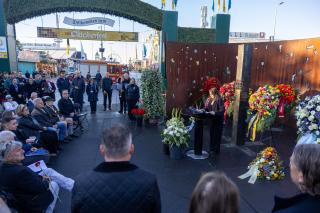
Commemoration ceremony featuring eyewitnesses and musical performances
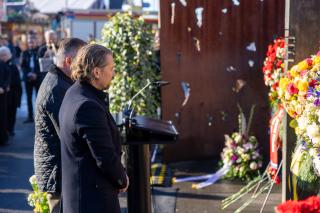
Magdalena Wesselly, spokesperson for the Munich Regional Youth Committee of DGB Youth, gave the opening remarks. This was followed by speeches from Mayor Mona Fuchs and Benedikt Knoche of the Munich Arbeiter-Samariter-Bund’s crisis intervention team. The memorial service was accompanied by music from the “Münchner Petersturmmusik” brass ensemble. The keynote address was delivered by Ramin Assisi, who had been on the scene as a first responder on September 26, 1980. A wreath-laying ceremony took place following the memorial service.
A trilingual announcement paid tribute to the victims
At around 8:45 a.m., a trilingual announcement in German, English, and Italian could be heard throughout the festival grounds. It provided information about the events of September 26, 1980, listed the names of those who lost their lives, and pointed out the memorial site at the main entrance to the Theresienwiese. At 9:00 a.m., the Oktoberfest opened its gates. Afterward, the DGB Youth continued their gathering as a vigil.
Commemoration of the Oktoberfest Bombing
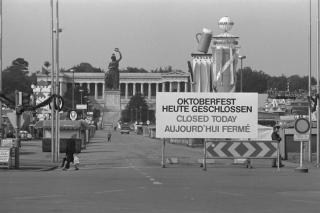
The Oktoberfest bombing is considered the deadliest right-wing terrorist attack in the history of the Federal Republic of Germany. Thirteen people lost their lives in the bombing on September 26, 1980, including the far-right extremist who carried out the attack. More than 200 Oktoberfest attendees were injured, some seriously.
Many survivors and relatives of the victims fought for decades for the truth to come to light and for recognition. To this day, they remain committed to ensuring that the victims are not forgotten and that their memory lives on.
Since 2020, the municipal memorial site “Dokumentation Oktoberfest-Attentat,” located directly at the main entrance to the Theresienwiese, has provided information about the bombing and its consequences. The focus is on the perspectives of those affected. The exhibition, organized by the Department of Culture of the City of Munich, was accessible to all and free of charge even during the Oktoberfest.