

Beer records, first roller coaster, the biggest beer tent: Incredible facts
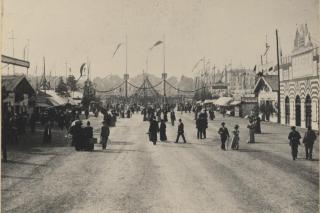
Oktoberfest has been taking place for over 200 years. Quite a few records have been set over that span of time. The most visitors came in 1985, the most beer was drunk in 1910, and the most famous custom didn’t come into being until 1950.
Beer record: Never has more been drunk than in 2011
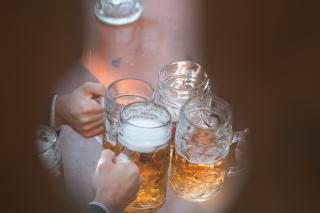
In 2011, more beer was drunk at Oktoberfest than ever before — and than ever since. A total of 79,225 hectoliters of beer were served: Well then, cheers!
Sad record: The longest break
Between 1939 and 1948, Oktoberfest was not held for ten years due to World War II. As a substitute and also as a distraction for the citizens of Munich in the post-war period, the smaller “Herbstfest” (Autumn Festival) was organized at the end of the 1940s. In 1919 and 1920, only a small “autumn festival” was celebrated due to the aftermath of World War I. In 1949, a regular Wiesn took place again. Most recently, Oktoberfest had to be canceled in 2020 and 2021 due to the coronavirus pandemic. In its history, the festival has been canceled a total of 26 times.
Record number of visitors in 2023
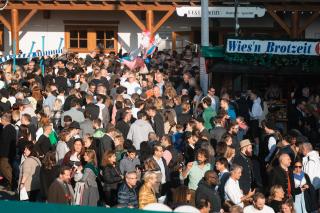
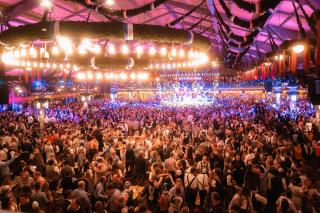
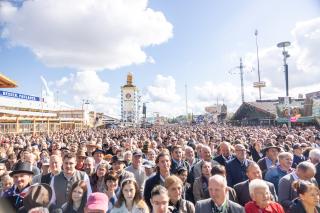
Most visitors came to Oktoberfest in 2023: around 7.2 million people attended the 18-day XXL edition, which was mostly blessed with late summer weather.
The most accurate marksman at the Wiesn
From 1960 to 1983, Karl Sorg took a portrait of himself every year at the “photo shooting” booth – with a rifle in his hand. How? When the target is hit in the center, a photo of the shooter is taken at this shooting gallery.
„Ozapft is!“ Ancient tradition or modern custom?
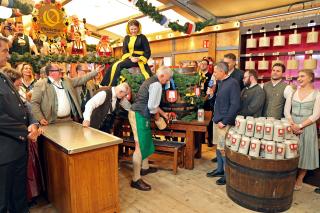
The tapping, i.e. the opening of the first beer barrel at Oktoberfest, is a tradition — albeit a relatively recent one: in 1950, the then mayor Thomas Wimmer uttered the famous words “Ozapft is!” for the first time. Since then, each of his successors has probably had more respect for the tapping than for election day, because the mayor's reputation depends on the number of strokes required.
Former mayor Christian Ude needed a whole seven strokes for his first tapping, which amused many in City Hall. But Ude practiced diligently, learned the right technique, and then even set a new record with only two strokes.
His successor, Dieter Reiter, may have learned a thing or two from his predecessor in terms of technique, as he only needed four strokes for his premiere—and has since also settled on two.
The largest tent ever erected on the festival grounds
The largest beer tent ever was the Pschorr-Bräurosl tent from 1913, which covered 5,500 square meters and could accommodate around 12,000 guests. Today, the Hofbräu tent is the largest in terms of capacity, with seating for 10,000 people.
Smart dogs
In 1880, a showman applied to perform at Oktoberfest with a family of trained dogs. The Astrakhan Spitz dogs were reportedly not only able to play cards and dance, but could also recognize all of Europe's rulers in photographs.
The first roller coaster in Munich
In 1908, Carl Gabriel presented Germany's first roller coaster at Munich's exhibition park, and the following year Max Stehbeck presented the first transportable “figure-8 coaster” at the Oktoberfest.
Still fit after ten beers?
A case from 1901 continues to amaze people to this day: Messrs. I. and M. Hager were awarded a diploma for drinking ten liters of beer at the Lang beer stand. Not to be imitated.
Advertising with beer-drinking children
Old postcards often depicted children drinking beer—not only the famous Münchner Kindl, but also other toddlers. Incidentally, the former was male until the 1930s, when it became a girl.
Help, we're out of beer!
One evening, the guests in the Hofbräu tent are particularly thirsty—and the landlord is slowly running out of beer. In his desperation, he asks his neighbor, who is also a landlord, for help. And so it happens that Paulaner beer is served in the Hofbräu tent for a few hours. The guests enjoy it nonetheless.
The Wiesn in the dictionary
The word “Wiesn” is officially added to the Duden dictionary. Following a large-scale initiative by Munich radio station Gong 96.3, supported by Minister President Horst Seehofer and Mayor Dieter Reiter, the synonym for “Oktoberfest” has made it into the digital version of the dictionary and, in 2020, into the 28th edition of the printed version. It is now officially clear: Wiesn and not Wies'n.
Ingenious lighting
In 1896, the electrical engineering company J. Einstein & Cie. installed the lamps in the tents. Albert, the owner's son, screwed light bulbs into the ceiling of the Schottenhamel Festhalle as a temporary job. Although the legend of Albert Einstein as an electrician cannot be proven or dated with certainty, the myth persists. But it is a great story nonetheless.
"Ein Prosit der Gemütlichkeit"
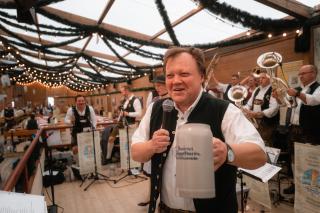
In 1898, the resourceful Oktoberfest host Gerog Lang introduced a thirty-piece band, Lang's original Oberlandler, for the first time in his newly built “Riesenfesthalle” (giant festival hall). To liven up the atmosphere in the tent, he had songbooks distributed so that guests could sing along. One of the songs that was there from the very beginning was the now ubiquitous “Prosit der Gemütlichkeit” (Cheers to conviviality).
The Trachten- und Schützenzug
In 1835, 1842, 1895, 1910, and 1935, parades to Theresienwiese took place as one-off events. It was not until 1948 that the annual traditional costume and riflemen's parade became one of the highlights of the festival program. Since 1956, the “Festring München e.V.” has been responsible for organizing the event.
Midsummer heat and winter cold
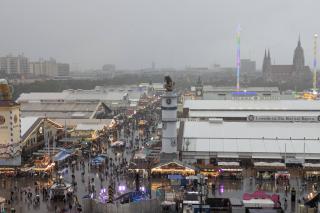
The coldest day at Oktoberfest was many decades ago. On September 29, 1936, there was a prolonged period of freezing temperatures, with the mercury dropping to just -2.5 degrees Celsius. Most recently, in 2002, a sudden onset of winter weather with snow surprised festival guests and left the festival tents covered in snow. The hottest day at Oktoberfest to date was the opening Saturday in 2025 on September 20. According to the German Weather Service, the thermometer rose to 30.7 degrees Celsius. On that day, very long lines formed at the drinking water stations.